As a supplier of Universal PTO Shafts, I often get asked about the moment of inertia of these crucial components. The moment of inertia is a fundamental concept in physics, especially when dealing with rotating objects. In the context of a Universal PTO Shaft, understanding its moment of inertia is essential for ensuring optimal performance, efficiency, and safety in power transmission systems.
What is Moment of Inertia?
Moment of inertia, also known as rotational inertia, is a measure of an object's resistance to changes in its rotational motion. It depends on the mass of the object and how that mass is distributed relative to the axis of rotation. Mathematically, the moment of inertia (I) of a point mass (m) at a distance (r) from the axis of rotation is given by the formula (I = mr^{2}). For more complex objects, such as a Universal PTO Shaft, the moment of inertia is calculated by integrating the contributions of all the infinitesimal mass elements that make up the shaft.
The moment of inertia plays a crucial role in determining how quickly an object can accelerate or decelerate its rotation. A higher moment of inertia means that more torque is required to change the object's rotational speed. In the case of a Universal PTO Shaft, this has significant implications for the power requirements and the overall performance of the power transmission system.
Factors Affecting the Moment of Inertia of a Universal PTO Shaft
Several factors influence the moment of inertia of a Universal PTO Shaft. These include the mass of the shaft, its length, diameter, and the distribution of mass along its axis.
- Mass: The total mass of the shaft is a primary factor in determining its moment of inertia. A heavier shaft will generally have a higher moment of inertia than a lighter one, assuming all other factors are equal. This is because more mass requires more torque to change its rotational state.
- Length: The length of the shaft also affects its moment of inertia. Longer shafts tend to have a higher moment of inertia because the mass is distributed over a greater distance from the axis of rotation. This means that it takes more torque to accelerate or decelerate a longer shaft compared to a shorter one.
- Diameter: The diameter of the shaft plays a role in the distribution of mass. A shaft with a larger diameter will have more mass located farther from the axis of rotation, resulting in a higher moment of inertia. Conversely, a shaft with a smaller diameter will have a lower moment of inertia.
- Mass Distribution: The way mass is distributed along the shaft is crucial. If the mass is concentrated near the ends of the shaft, the moment of inertia will be higher than if the mass is evenly distributed. This is because the mass at the ends is farther from the axis of rotation, contributing more to the moment of inertia.
Calculating the Moment of Inertia of a Universal PTO Shaft
Calculating the moment of inertia of a Universal PTO Shaft can be a complex task, especially for shafts with irregular shapes or non - uniform mass distributions. However, for simple cases, such as a solid cylindrical shaft, the moment of inertia can be calculated using well - established formulas.
For a solid cylindrical shaft of mass (m), length (L), and radius (R) rotating about its central axis, the moment of inertia is given by the formula (I=\frac{1}{2}mR^{2}). This formula assumes that the mass is evenly distributed throughout the shaft.
In more complex situations, numerical methods or computer - aided design (CAD) software can be used to calculate the moment of inertia. These tools can take into account the exact shape and mass distribution of the shaft, providing a more accurate result.
Importance of Moment of Inertia in Universal PTO Shaft Applications
The moment of inertia of a Universal PTO Shaft has several important implications in its applications.
- Power Requirements: A higher moment of inertia means that more power is required to start and stop the rotation of the shaft. This can affect the overall efficiency of the power transmission system, as more energy is needed to overcome the shaft's resistance to changes in rotational motion.
- Torque Transmission: The moment of inertia also affects the torque transmission capabilities of the shaft. A shaft with a high moment of inertia can store more rotational energy, which can be beneficial in applications where sudden changes in load occur. However, it also means that more torque is required to change the shaft's rotational speed, which can put additional stress on the components of the power transmission system.
- System Stability: The moment of inertia can influence the stability of the power transmission system. A shaft with a high moment of inertia can help to smooth out fluctuations in rotational speed, reducing the risk of vibrations and mechanical failures. On the other hand, if the moment of inertia is too high, it can make the system more difficult to control, especially in applications where rapid changes in speed are required.
Related Shafts and Their Moment of Inertia
In addition to Universal PTO Shafts, there are several other types of shafts used in power transmission systems, each with its own moment of inertia characteristics.
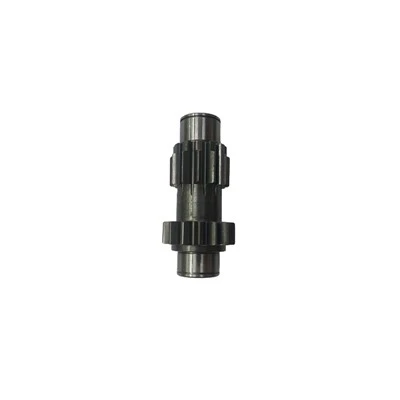
- Gearbox Drive Shaft: Gearbox drive shafts are used to transmit power from the engine to the gearbox. The moment of inertia of a gearbox drive shaft depends on its design, mass, and the distribution of mass along its axis. A well - designed gearbox drive shaft should have a moment of inertia that allows for efficient power transmission and smooth operation of the gearbox.
- Pto Input Shaft: The PTO input shaft is responsible for transferring power from the engine to the power take - off unit. The moment of inertia of the PTO input shaft can affect the performance of the PTO system, as it determines how quickly the PTO can start and stop. A lower moment of inertia can result in faster response times, while a higher moment of inertia can provide more stability.
- Billet Output Shaft: Billet output shafts are often used in high - performance applications. The moment of inertia of a billet output shaft is influenced by its material, shape, and size. A billet output shaft with a low moment of inertia can help to improve the acceleration and deceleration of the system, while a higher moment of inertia can provide more torque - carrying capacity.
- Planetary Gear Shaft: Planetary gear shafts are an integral part of planetary gear systems. The moment of inertia of a planetary gear shaft affects the overall performance of the gear system, including its efficiency, torque transmission, and speed control. A well - designed planetary gear shaft should have a moment of inertia that is optimized for the specific application.
- Power Transmission Shaft: Power transmission shafts are used to transfer power between different components of a machine. The moment of inertia of a power transmission shaft is an important factor in determining the power requirements and the overall performance of the system. A shaft with a high moment of inertia can store more energy, but it also requires more power to start and stop.
Conclusion
In conclusion, the moment of inertia of a Universal PTO Shaft is a critical parameter that affects its performance, efficiency, and safety in power transmission systems. Understanding the factors that influence the moment of inertia and how to calculate it is essential for designing and selecting the right shaft for a specific application.
As a supplier of Universal PTO Shafts, we are committed to providing high - quality products that are optimized for performance and reliability. Our team of experts can help you select the right shaft based on your specific requirements, taking into account the moment of inertia and other important factors.
If you are interested in purchasing Universal PTO Shafts or have any questions about their moment of inertia or other technical aspects, please feel free to contact us for a detailed discussion and procurement negotiation. We look forward to working with you to meet your power transmission needs.


References
- Halliday, D., Resnick, R., & Walker, J. (2014). Fundamentals of Physics. Wiley.
- Shigley, J. E., & Mischke, C. R. (2003). Mechanical Engineering Design. McGraw - Hill.
- Norton, R. L. (2004). Design of Machinery: An Introduction to the Synthesis and Analysis of Mechanisms and Machines. McGraw - Hill.